 When Heinrich Hertz discovered radio waves in 1888, he could hardly have imagined the incredible applications that would emerge a century later in the packaging industry.
RF and RFID labels are among the many technologies derived from this discovery.
Used across numerous industries, RF and RFID labels address different needs.
- RF: Radio Frequency
- RFID: Radio Frequency Identification
RF Labels
General information about RF Labels
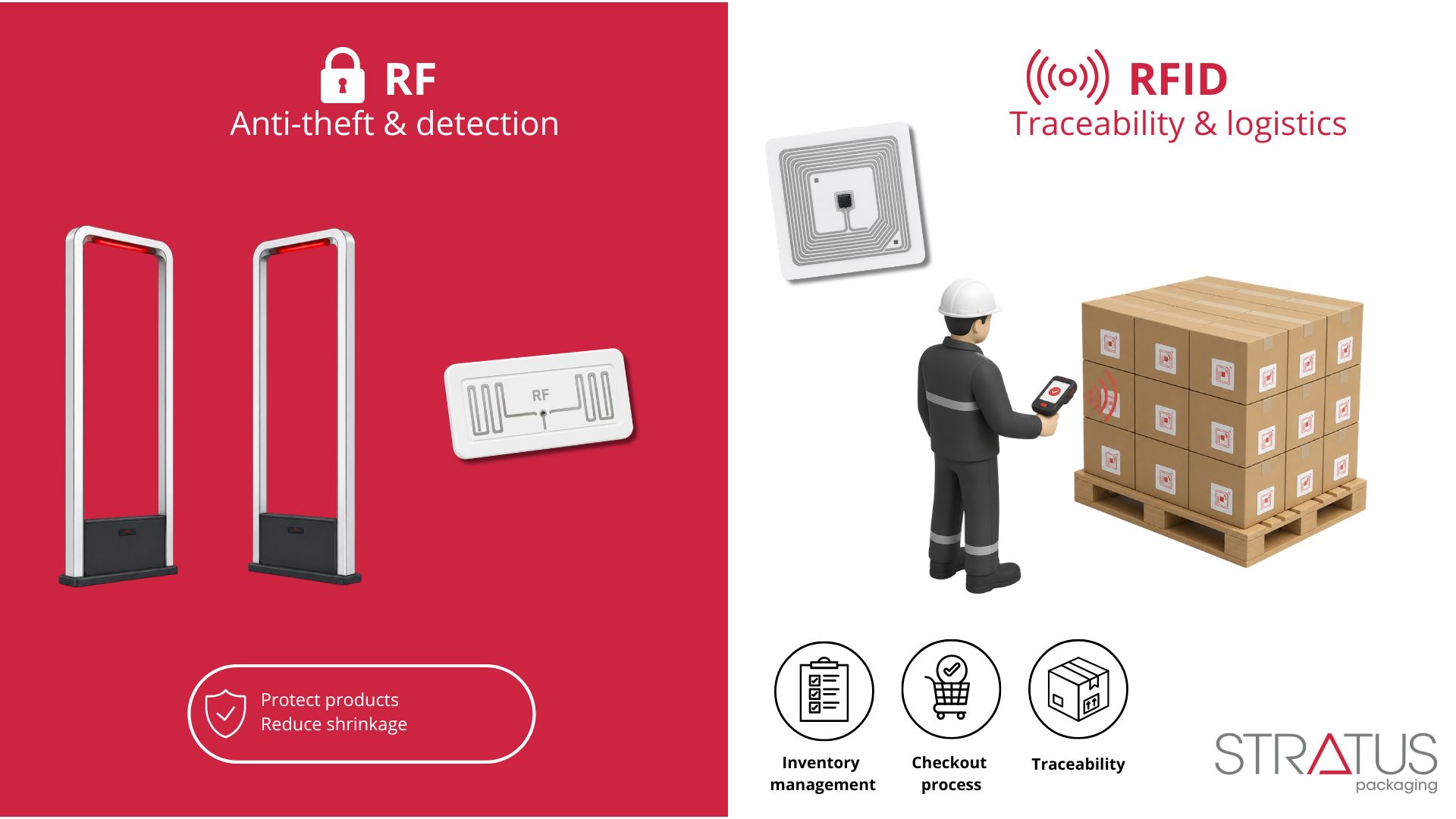
RF (Radio Frequency) technology differs from RFID (Radio Frequency Identification) because it does not include a chip or memory. It only contains an antenna. In most cases, this antenna acts as an anti-theft device. Detection gates located at checkout counters or store exits detect the antenna.
In France, unknown shrinkage is estimated to represent around 1.4% of a store’s turnover. In some industries, this figure can reach 4% to 5% of total revenue. Retailers therefore need effective anti-theft solutions to reduce these losses.
Consumer products most affected by shrinkage and therefore by RF anti-theft labels include:
- cosmetics
- wines and spirits
- clothing
- perfumes
- razor blades
- certain food products such as meat or cheese
After anti-theft filaments (which involve specific manufacturing constraints such as minimum length and cutting requirements), RF labels remain one of the most widely used technologies to prevent shoplifting.
These labels are commonly referred to as:
- radio frequency labels
- RF labels
- anti-theft tags
- RF tags
- EAS labels (Electronic Article Security)
How RF Tags work
RF antennas can be detected by security gates but cannot communicate with them.
Current European standards define an operating frequency of 8.2 MHz for most detection gates used in Europe. However, some foreign systems may operate on different frequencies. In such cases, the antenna may become incompatible with the detection system.
Most RF antennas available on the market can be deactivated. As a result, a product purchased in Store A will not trigger alarms in Store B.
RF Label shapes & formats
RF labels generally come in simple shapes such as:
- square
- round
- rectangular
Among the most common formats are:
- 30 x 30 mm square
- 40 x 40 mm square
- 30 mm diameter
- 15 x 52 mm rectangle
Important: RF labels (anti-theft labels) should not be confused with labels used for automatic checkout systems, even though those systems may also include anti-theft functionality.
Most RF labels are available in transparent or white versions. The white version consists of a laminated white paper layer placed over the label. This paper can be printed using either thermal transfer or direct thermal printing.
Applications of RF Labels
Most RF anti-theft labels are not suitable for cold or humid environments. Low temperatures can reduce antenna detection performance. However, one European supplier offers an anti-theft tag specifically designed for fresh and frozen products, capable of operating down to -18°C.
It is also important to note that an RF anti-theft antenna attached to a metal can cannot be detected. While liquids generally do not interfere with detection, metal makes the tag undetectable.
Another important point concerns microwave use. Since RF labels partly contain metal, they are generally not microwave-compatible. Some manufacturers now offer special RF tags designed specifically for microwave applications.
RFID Labels
General information about RFID technology
Reminder: RFID stands for Radio Frequency Identification.
RFID labels (or RFID tags) contain both an antenna and a microchip capable of storing traceability, logistics, and product identification data.
Historical RFID applications include:
- highway toll collection systems
- animal and livestock identification
More recent applications include:
- industrial logistics
- pharmaceuticals
- food processing
- automotive industry
- bike-sharing systems such as Vélib’ or Vélo’v
- transportation cards such as the Navigo pass
- contactless payment systems
HF and UHF RFID technologies
RFID technology mainly operates on two frequency ranges:
- HF (High Frequency) at 13.56 MHz
- UHF (Ultra High Frequency) from 860 to 960 MHz depending on the region
In Europe, UHF systems typically operate around 867 MHz. In the United States and Asia, reading frequencies are generally closer to 920 MHz.
It is easy to visually distinguish HF labels from UHF labels because their antennas have different structures:
- HF antennas are closed-loop circuits
- UHF antennas are open circuits, commonly referred to as dipoles
Examples of HF antennas (loop circuits)
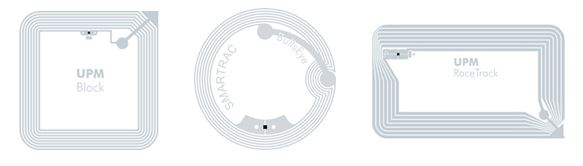

Examples of HF antennas (loop circuits)
Operation of HF and UHF Technologies
In HF (13.56 MHz), the reader creates a magnetic field that activates the chip in order to communicate with it. The reading distance remains relatively short, around 1 meter.
In UHF (from 860 to 960 MHz), radio frequencies activate both the antenna and the chip. Reading distances can then reach 7 to 10 meters.
Another RFID technology has recently emerged on the market: NFC (Near Field Communication), widely used in smartphones and smart cards.
NFC operates on the same frequency as HF antennas (13.56 MHz) but requires near contact, typically between 2 and 3 cm, to allow communication between the chip and the reader.
RFID and NFC Standards
These different technologies are governed by European and international standards.
In HF, there are mainly three standards:
- ISO 18000-3 (HF)
- ISO 15693 (HF)
- ISO 14443 (NFC)
The ISO 15693 standard is mainly used in libraries and pharmaceutical applications. The reading distance is approximately 1 meter.
The ISO 14443 standard is mainly used for payment cards and mobile applications. In NFC, the reading distance is around 25 mm.
In UHF, the most widely used standard is ISO 18000-6C, also known as EPC UHF Gen 2. This standard is now the global reference for RFID marking of manufactured products.
Characteristics of RFID Chips
Each chip is generally identified by a unique tid/uid number. The reader can read this number and assign it to the labeled product. This identifier does not use memory space and cannot be erased.
The EPC zone is a memory area that facilitates fast chip reading, especially in UHF. Memory capacity is often 128 bits in UHF but can reach 512 or 1024 bits in HF.
Technical datasheets often mention “EPC Class 1 Gen 2,” corresponding to the EPC standard readable from 860 to 960 MHz.
Today, some chips also include an extended memory area called “user memory.” This additional capacity can reach up to 1024 bytes in UHF.
MIFARE chips, based on older technology, are now much less commonly used.
RFID Innovations and New Developments
New SLX2 chips offer multiple-reading capabilities. A single reader can therefore scan several chips simultaneously.
Some manufacturers also offer RFID tags compatible with both UHF and NFC. A single chip can then communicate using both protocols.
In UHF, MONZA 4D technology evolved into MONZA 5 and later into MONZA R6 and MONZA R6P solutions, offering enhanced features and performance.
One manufacturer also offers a UHF tag that can be read on metallic surfaces, provided the reader maintains direct visibility of the tag and stays within a maximum distance of around 4 meters.
Presentation of RFID Tags
All the technologies described above are now available as adhesive labels. However, antennas are not initially manufactured in this format.
Manufacturers produce RFID antennas in continuous rolls and in very large quantities. These antennas are then converted into adhesive labels.
Before conversion, they are referred to as RFID inlays. These inlays have specific pitch and spacing dimensions that rarely match end-user requirements.
There are mainly two types of RFID inlays:
Wet Inlays
- adhesive RFID tags
- paper or transparent
- supplied as rolls or die-cut labels
Dry Inlays
- non-adhesive RFID tags
- supplied in rolls
By default, tags are transparent, although paper versions (vellum) are also available.
Interaction Between RFID Tags and Their Environment
Reading distances and RFID chip performance depend heavily on the surrounding environment.
Water and liquids generally do not affect HF ISO 15693 or NFC performance. However, metals strongly interfere with antenna operation.
In UHF, neither water nor metal is compatible with optimal antenna reading. The tag therefore needs to be separated from the liquid or metal surface using foam or an air gap.
Metal also acts as a barrier to the magnetic field. For example, on a pallet of canned goods, the reader will generally only read the first row correctly.
RFID and Anti-Theft Functionality
RFID labels do not replace RF anti-theft labels because they operate on different frequencies. Even HF RFID tags operating at 13.56 MHz cannot be detected by RF anti-theft gates operating at 8.2 MHz.
However, some stores use RFID labels for automatic checkout and instant inventory management. If a product is not scanned at checkout, it is still considered present in stock. Exit gates can then detect this discrepancy and trigger an alert.
RFID technology therefore combines three functions:
- instant shelf inventory
- automatic checkout
- anti-theft protection
STRATUS Applications
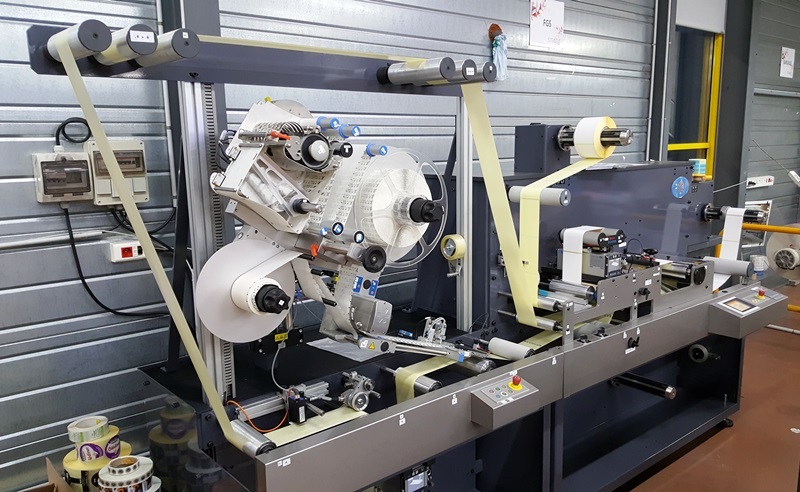
For several years, STRATUS PACKAGING has been equipped with a solution for integrating RF and RFID antennas.
Several options are available:
- STRATUS supplies the tags based on customer specifications
- the customer directly supplies the RF or RFID tags
Technically, the tags can be:
- inserted under an adhesive label or resealable multipage label (between the adhesive and the backing liner)
- applied to the front side of an adhesive label, multipage label, or shrink sleeve…